 Skip to main content
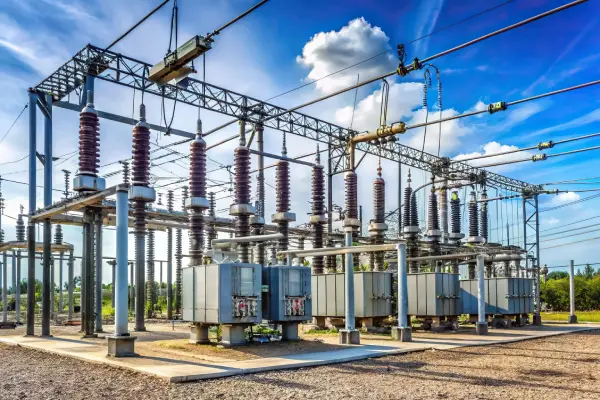



Modern transmission and distribution grids depend on robust substation engineering to maintain grid stability, ensure reliable power flow, isolate faults, and uphold system safety. In large-scale renewable energy and utility networks, substations serve as critical nodes for power transformation, voltage regulation, protection, control, and reliable power evacuation. At QQ Engineering & Consulting (QQEC), our substation engineering capabilities support utility, renewable energy, and power infrastructure projects across a range of voltage levels, including EHV substation engineering.
What Is a Substation?
A substation is a facility within an electrical power system used to transform voltage levels, switch and control electrical circuits, provide protection and isolation and facilitate the reliable transfer of electrical power between transmission, distribution, generation, and industrial networks. The substation is equipped with power transformers, switchgear, and advanced metering used to transform voltage levels for efficient transmission, to reduce bulk power for regional distribution networks, and to provide secure points of common coupling (PCC) to utility and renewable energy resources.
Types of Substations
Substations are generally classified according to the role they play in the electrical network topology:
● Transmission Substations:
Bulk power facilities connect multiple extra-high-voltage lines (up to 765 kV) to step voltages up or down for regional power wheeling and long-distance transport.
● Distribution Substations:
Intermediate stations that step down the transmission voltage to medium-voltage feeders for local industrial, commercial, and residential consumption.
● Pooling Substations:
Renewable-energy substations that collect power from multiple medium-voltage feeders originating from solar PV or wind generation blocks and transform it to a higher voltage for transmission line engineering and power evacuation.
● Switching Substations:
Facilities operated primarily at a single voltage level and intended for switching, interconnection, load transfer, and isolation of transmission or distribution circuits without voltage transformation.
AIS substation, GIS substation layouts, or combinations of them are employed depending on site specifics and life cycle costs.
AIS vs GIS Substations
Choosing between an AIS substation and a GIS substation requires balancing site conditions against capital and operational expenditure budgets.
| Parameter | AIS | GIS |
| Footprint | Larger; requires greater electrical clearances | Compact; suitable for space-constrained sites |
| Installation | Generally simpler outdoor installation | More specialized installation and assembly |
| Environmental exposure | More exposed to pollution, dust, humidity and salt contamination | Enclosed construction provides better environmental protection |
| Initial equipment cost | Generally lower | Generally higher |
| Land requirement | Higher | Lower |
| Maintenance | More exposed equipment; maintenance requirements depend on site conditions | Generally lower routine exposure-related maintenance |
| Site suitability | Rural/open sites with available land | Urban, industrial, coastal or space-constrained sites |
| Expansion | Generally easier depending on configuration | More complex and manufacturer/configuration dependent |
Switchyard Design
High-voltage switchyard design must be flexible while maintaining electrical clearances that meet IEC and IEEE standards. Engineers develop the single-line diagram (SLD) and select an appropriate busbar arrangement such as single bus, double bus, double-breaker, or breaker-and-a-half based on reliability, maintainability, operational flexibility, fault levels, space and cost requirements.
Key substation electrical engineering factors include:
● Diagram of circuit breakers, disconnectors, fast-acting earthing switches, and instrument transformers.
● Maintenance clearances and required phase-to-phase and phase-to-earth electrical clearances.
● Substation earthing-grid design in accordance with IEEE Std 80 and lightning-protection design in accordance with the IEC 62305 series.
● Cable-trench layouts, segregation of power and control cables, and integration with control-room systems.
Protection & Control Systems
Modern transmission and distribution networks rely on robust substation engineering to maintain grid stability, isolate electrical faults, protect critical equipment and ensure safe and reliable power transmission and distribution. Relays take analog inputs from current and voltage transformers and respond by tripping various busbars, transmission lines, and power transformer banks.
Secondary systems include:
● Differential, distance, overcurrent, and breaker failure protection.
● Substation automation systems (SAS) and SCADA architectures according to IEC 61850 protocols.
● Communications over optical fibres, mechanical interlocks, and local human-machine interfaces (HMI).
● Protection settings and relay coordination are validated through comprehensive power system studies to achieve selectivity, sensitivity, reliability and appropriate fault-clearing times.
Substation Detail Engineering Deliverables
We provide detailed engineering for substations to help translate the layout concept into a substation detail engineering package. Depending upon the scope of the project, utility interconnection standards, and statutory codes, detail engineering for substations can include:
● Overall Single Line Diagrams (SLDs), Key SLDs, and Protection & Metering SLDs.
● General Arrangement (GA) layout plans, switchyard elevation sections, and equipment clearance drawings.
● Equipment sizing calculations, including busbar ampacity and short-circuit withstand, battery bank capacity, auxiliary transformer sizing, AC/DC auxiliary system sizing and other major equipment ratings.
● Grounding grid simulations of substation earthing (soil resistivity, touch/step potential, IEEE 80)
● Lightning protection layout and shielding failure risk assessments.
● Including cable route, trench design, and schedule of complete control/power cables.
● Civil and structural deliverables include equipment support structures, gantry towers, and transformer plinth foundation drawings.
● Control room layouts, AC/DC distribution board diagrams, and Bill of Quantities (BOQ) files.
● Final Issued-for-Construction (IFC) engineering packages, vendor drawing reviews, technical bid evaluations and as-built documentation.
Substation Engineering Services by QQEC
We offer complete substation engineering services, from pre-bid studies and owner’s engineering to detailed engineering packages for AIS, GIS and hybrid substations up to 765 kV. Our engineers combine civil foundation design, high-voltage electrical engineering, and automation to reduce grid interconnection times for industrial and utility-scale solar PV plant engineering projects.
Frequently Asked Questions
1. What is a substation, and why is it important?
A. A substation is a critical component of an electrical power system that transforms voltage, switches electricity, isolates faults, and controls the flow of electric power. It is vital for the safe and reliable transmission of electricity between generating stations, transmission networks, distribution systems, industrial facilities, and projects that use renewable energy.
2. What are the main types of substations?
A. The most common substations are transmission and distribution substations, pooling substations, and switching substations. Transmission and distribution substations change the voltage to deliver power; pooling substations collect electricity from renewable energy projects and facilitate the evacuation of power to the transmission grid. Switching substations control and isolate circuits without changing the voltage.
3. What is the difference between AIS and GIS substations?
A. An Air-Insulated Substation (AIS) uses atmospheric air as an insulation layer. It requires more land and larger electrical clearances. A Gas-Insulated Substation (GIS) stores high voltage equipment in small, sealed rooms. It is well suited to urban, coastal, industrial and other space-constrained locations. AIS is generally less expensive to build than GIS, while the GIS has a smaller footprint and provides better protection from environmental contamination and exposure.
4. What is substation detail engineering?
A. Detailing includes drawing up single-line diagrams, general arrangement layouts, equipment sizing calculations, earthing grid design, lightning protection layouts, cable routing and trench drawings, protection and metering plans, AC/DC, civil and structural drawings, Bills of Quantities, vendor-document reviews, and Issued-for-Construction packages.
5. What is included in substation protection and control engineering?
A. Protection and control engineering involves the design and coordination of differential, distance, overcurrent, earth-fault and it should be a breaker-failure protection systems. There are relay settings, protection and metering diagrams, substation automation, SCADA communication, control interlocks, HMI systems, and AC/DC control power.
6. How does QQEC support substation engineering projects?
A. QQ Engineering & Consulting provides substation engineering services for utility, industrial, and renewable energy projects, from pre-bid and feasibility studies to basic and detailed engineering. Services include electrical, civil, structural, protection, automation, earthing, lightning protection, and grid interconnection engineering for utility, industrial, and renewable energy projects.
